Kemet Beyond the Pyramids · Episode 1
Anatomy of a Jewel
How a 3,900-year-old pectoral was designed, sourced, made and finished
In February 1914, archaeologists working near the pyramid of King Senwo-sret II at Lahun found a small recess in a robbed tomb. Robbers had missed it. Floods had filled it three-quarters with mud. When the mud was cleared, out came the jewellery of a princess called Sithathoryunet.
Among it was a chest ornament, a pectoral, only 8.2 centimetres wide. It is now in the Metropolitan Museum in New York, and many people call it the most beautiful piece of jewellery to survive from ancient Egypt.
Most visitors admire it and move on. I want to do something different: take it apart, the way an engineer would, and ask how it was made. Because a jewel like this does not begin with gold. It begins with a plan.
1. The design: a sentence in gold
Every shape on the pectoral is a hieroglyph:
- Two falcons: the sun god.
- Two cobras wrapped around sun discs: the protector goddesses of Upper and Lower Egypt.
- Two ankhs hanging from the cobras: life.
- A kneeling god, Heh, holding notched palm ribs: millions of years.
- An oval cartouche with the king's throne name, Khakheperre.
- Zigzag lines at the base: the waters of creation.
Read together: The sun god grants life and power to King Senwo-sret II for millions of years.
Someone had to compose that message, and fit it into a space smaller than your palm, perfectly balanced left and right. That is the work of a designer who knew the script, the religion and the rules of royal art. Before any gold was melted, the whole piece existed as a drawing.
2. The materials: mining and trade
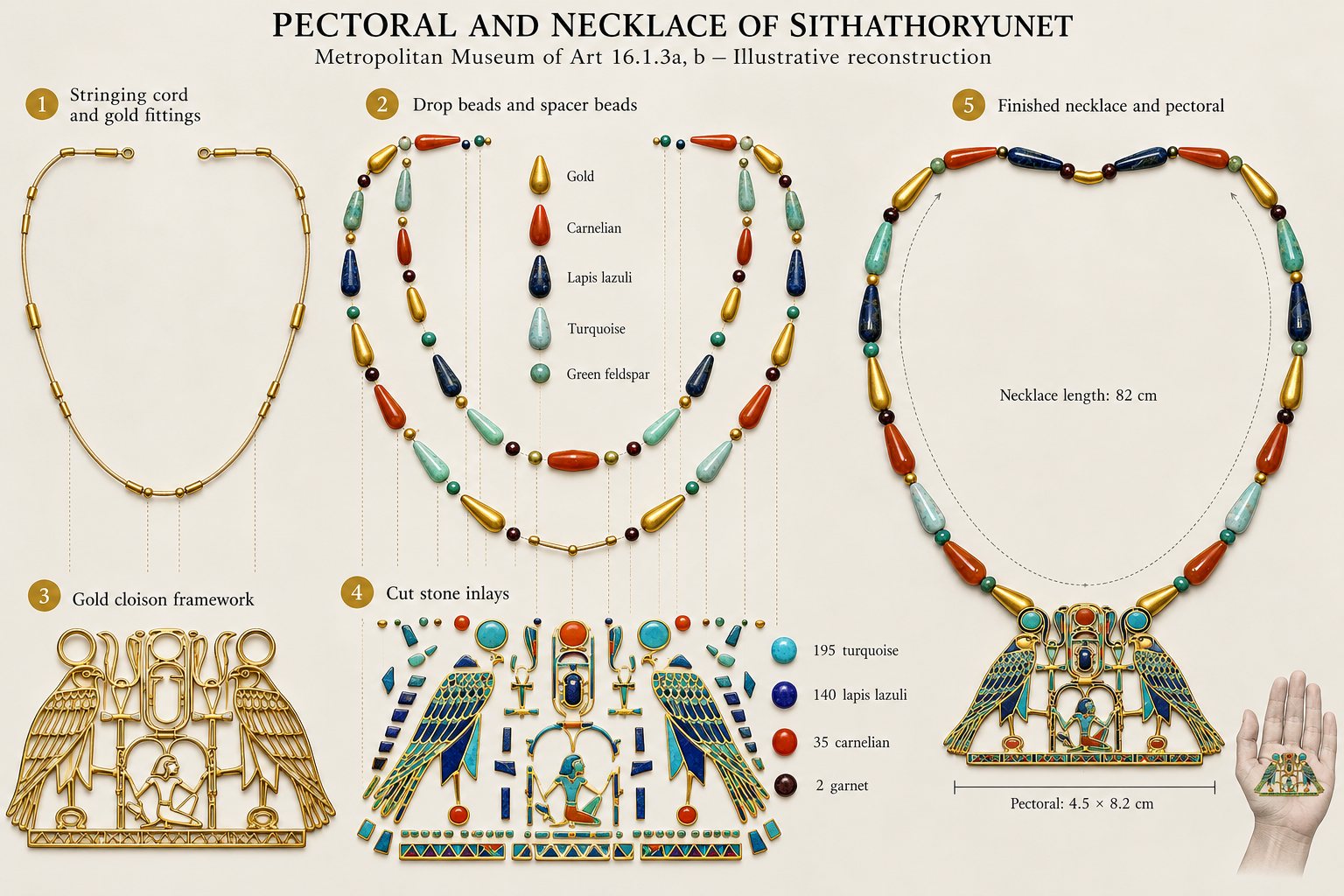
The pectoral contains 372 small stones: 195 of turquoise, 140 of lapis lazuli, 35 of carnelian and 2 of garnet. The necklace it hangs on adds beads of gold, carnelian, lapis, turquoise and green feldspar. So the whole piece uses six materials, and each came from a different place.
- Gold came from the mines of Egypt's Eastern Desert and from Nubia in the south.
- Turquoise came from the mines of Sinai, reached by state expeditions of miners, soldiers and supply teams.
- Carnelian, the red stone, was found in Egypt's own deserts.
- Lapis lazuli, the deep blue, was not Egyptian at all. It came from the mountains of Badakhshan, in today's Afghanistan, more than 3,000 kilometres away, passed from trader to trader along caravan routes.
- Garnet, a dark red stone, appears only twice in the pectoral, as tiny accents.
- Green feldspar, used in the necklace beads, stood for fresh plants, growth and rebirth.
So before the jeweller started, Egypt needed mining expeditions, desert transport and long-distance trade. One small jewel depended on a supply chain that crossed half of the known world.
3. Forging and shaping
The pectoral is built like a tiny honeycomb. The jeweller started with a thin sheet of gold as the back plate. Onto it he soldered narrow strips of gold, standing on edge, to form 372 little cells. This technique is called cloisonné, from the French word for "partitioned".
Then each stone had to be cut and ground by hand to fit its own cell exactly, with no gaps. Some pieces are smaller than a grain of rice. The feathers of a falcon's wing, for example, are made of rows of tiny stones, each shaped differently.
The gold strips are so fine that a moment too long in the fire would melt them. Soldering them in place, without a thermometer, took judgement that only years of practice could give.
4. The people and their tools
We do not know the names of the craftsmen who made this pectoral. But tomb paintings show us how Egyptian jewellers worked.
They show metalworkers blowing through long pipes to make a small fire hot enough to melt gold. In the tomb of the vizier Rekhmire at Thebes, painted a few centuries later, one craftsman drills holes in beads with a bow drill, while another strings a collar. Stones were shaped with harder stones and abrasive sand, and polished by hand.
These workshops were organised. Gold and precious stones were weighed when issued and weighed again when the work came back. Scribes kept records. A designer, a goldsmith, a stone cutter, a bead maker and a finisher could all touch the same piece.
5. Finishing and presentation
Turn the pectoral over, and there is a surprise. The back, which would rest against the princess's skin and which no one else would ever see, is a second work of art. The falcons' wings are raised from behind, and every feather, scale and strand of hair is engraved in fine lines.
Quality that no one sees was still quality.
Why take that trouble? Because this jewel was not made only for people to look at. It was made for the gods, and for eternity.
Finally the surfaces were polished, and the pectoral was hung on a necklace of gold, carnelian, lapis, turquoise and green feldspar beads, 82 centimetres long. It was worn on the chest, over the heart: the place Egyptians believed held a person's mind and character.
What one jewel teaches us
Put it all together. To make one pectoral, Egypt needed:
- A designer who could turn a prayer into a picture.
- Miners, traders and expeditions to bring materials from Sinai, Nubia and Afghanistan.
- The skill to work gold finer than a fingernail.
- Trained craftsmen, tools and an organised, recorded workshop.
- Standards high enough to finish the parts no one would see.
That is not only art. It is engineering, logistics, management and a culture of quality, 3,900 years ago.
Ancient Egypt was more than pyramids and mummies. Sometimes the whole civilization fits in the palm of your hand.
Ashraf Osman writes about ancient Egypt for everyone who loves it, starting with children and young adults. His books for young readers tell Egyptian history from a human point of view, so readers live the experience instead of memorising dates. This is episode 1 of Kemet Beyond the Pyramids.